Starting a home workout routine can be a convenient way for beginners to become more active. You do not need a gym membership or expensive fitness equipment. With a little space and some simple exercises, you can create a workout that fits your schedule.
I think beginners should focus on simple movements rather than complicated exercises. The purpose of your first workouts should be learning how to move correctly, building confidence, and developing consistency.
Here are several beginner friendly home workout ideas that can help you get started.
Start With Marching in Place
Marching in place is an easy way to begin a home workout.
Stand comfortably and lift one foot at a time while moving your arms naturally. Continue for one or two minutes.
You can gradually increase the speed if you feel comfortable.
This exercise requires very little space and can be used as a warm up or as part of a simple cardio workout.
Bodyweight Squats
Squats are a useful beginner exercise because they work the lower body.
Stand with your feet comfortably apart. Bend your knees and lower your body in a controlled movement, then return to standing.
Beginners can use a chair for support if needed.
Focus on controlled movement instead of trying to perform as many repetitions as possible.
Wall Push Ups
Wall push ups are an excellent starting point for people who find traditional push ups difficult.
Place your hands against a wall and position your body comfortably. Bend your elbows to move closer to the wall, then push yourself back.
As your strength improves, you can eventually progress to an easier floor based variation.
Glute Bridges
Glute bridges are simple and can be performed on the floor.
Lie on your back with your knees bent. Keep your feet on the floor and slowly raise your hips. Pause briefly before lowering them.
Repeat the movement at a comfortable pace.
This exercise can be included in a beginner lower body workout.
Chair Exercises
A sturdy chair can be useful for beginners.
You can perform chair squats, supported leg raises, or other simple movements.
Chair based exercises can provide additional stability while you learn new movements.
Always make sure the chair is stable and placed on a safe surface before using it for exercise.
Beginner Planks
Planks can help develop core strength.
If a standard plank feels too difficult, start with a modified version.
Hold the position for a short period and focus on maintaining comfortable alignment.
Gradually increase the duration as you become stronger.
There is no need to hold the plank for a very long time when you are just starting.
Step Ups
If you have a stable and appropriate step, step ups can be included in a home workout.
Step onto the platform carefully and return to the starting position.
Use a low step at first and make sure the surface is secure.
If you do not have a suitable step, simply leave this exercise out and use another movement.
Add Gentle Stretching
Stretching can be included before or after your workout depending on your routine.
Gentle stretches can help you move through a comfortable range of motion.
Avoid bouncing or forcing your body into uncomfortable positions.
Create a Full Body Home Workout
You can combine several exercises into one simple routine.
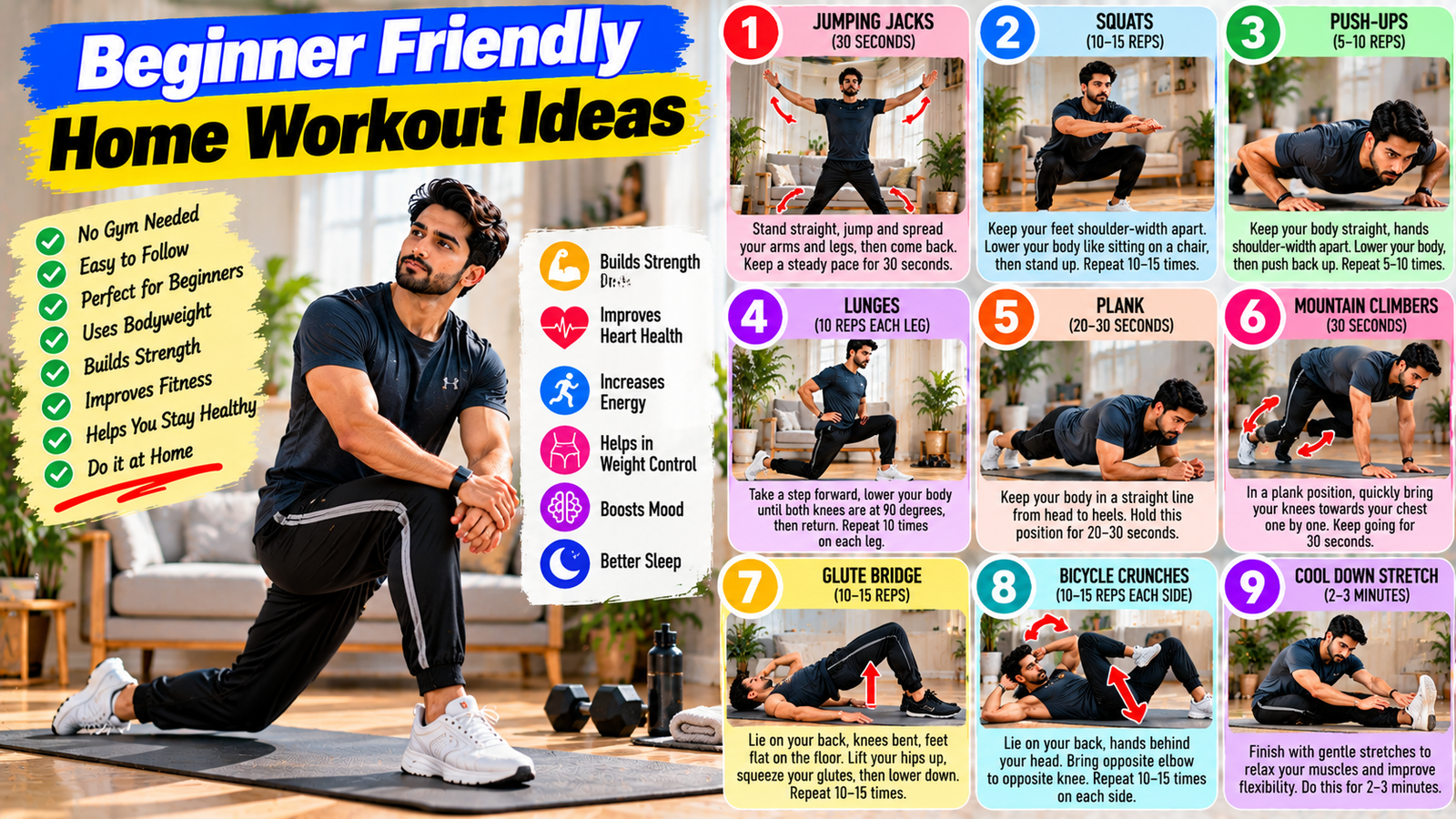
For example, begin with marching in place, followed by bodyweight squats, wall push ups, glute bridges, and a modified plank.
Perform each exercise for a manageable number of repetitions or for a short amount of time.
Rest between exercises whenever necessary.
Keep Your First Workout Short
Beginners do not need to exercise for an hour.
A 15 to 25 minute home workout can be a practical starting point.
If you feel comfortable after several weeks, you can gradually increase the duration.
The goal is to create a routine that fits into your lifestyle.
Focus on Good Form
Proper technique is important.
Perform exercises slowly enough that you can control the movement.
If you are unsure how an exercise should be performed, learn the basic technique before adding more repetitions.
Quality movement is more important than trying to finish a large number of repetitions quickly.
Rest When Necessary
Your body needs recovery time.
If you are new to exercise, give yourself rest days between more demanding workouts.
You can still walk or perform gentle movement on those days if you feel comfortable.
If you experience unusual pain, dizziness, or severe discomfort, stop exercising and seek appropriate professional advice.
Make Your Home Workout Enjoyable
You are more likely to maintain a routine if you enjoy it.
You can listen to music, exercise with a family member, or change your exercises occasionally.
However, avoid changing your routine so often that you never become comfortable with the basic movements.
A little variety can be helpful, but consistency should remain the priority.
Final Thoughts
Beginner friendly home workouts do not need to be complicated. Marching in place, squats, wall push ups, glute bridges, chair exercises, modified planks, and gentle stretching can provide a simple foundation.
Start slowly, focus on technique, and increase the difficulty gradually.
In my view, the biggest advantage of exercising at home is convenience. You can work out without traveling to a gym, and you can choose a schedule that fits your daily life.
The most effective beginner workout is one that you can perform safely and consistently.